The following article is based on an excerpt from Keepers of the Sheep: Knitting in Morocco’s High Atlas and Beyond by Irene Waggener with Muah Ahansali, Hussein Mardi, Muah n’Ait Tabatoot, and Noura Eddelymy.
“Welcome to Timloukine!” Nora said brightly as we reached the top of a steep river bank. We were standing on the edge of a small terraced field full of bright green alfalfa below a village of rammed-earth homes made from the valley’s rust red soil. Surrounding us were the tall, snow-capped peaks of Morocco’s High Atlas Mountains. The bucolic view was punctuated by the sound of bah-ing from small flocks of sheep grazing on the slopes both near and far. We followed a dirt mule track into the village.
The raoud was a one-room school building in the middle of Timloukine. It had a door, badly damaged chalkboard, and teacher’s desk on one end. Faded straw mats covered the hard, cement floor and wooden benches lined the robin’s-egg-blue walls. A faded portrait of Mohammed VI, Morocco’s current king, was tacked high on the back wall. Blue plastic stools, many with broken seats, were stacked in the corners. The raoud had not seen a class in several months. Although the community welcomed the teachers sent to them, the assignees only lasted a few days or weeks in the small village far removed from the hubbub of towns and cities. Nora, however, had accepted an offer to be the new pre-school teacher at the start of the upcoming school year, something the community waited for with anticipation. For now, Timloukine’s women’s cooperative—of which Nora was the current leader—used it as their meeting room.
Crafting Yarn, Thick and Thin
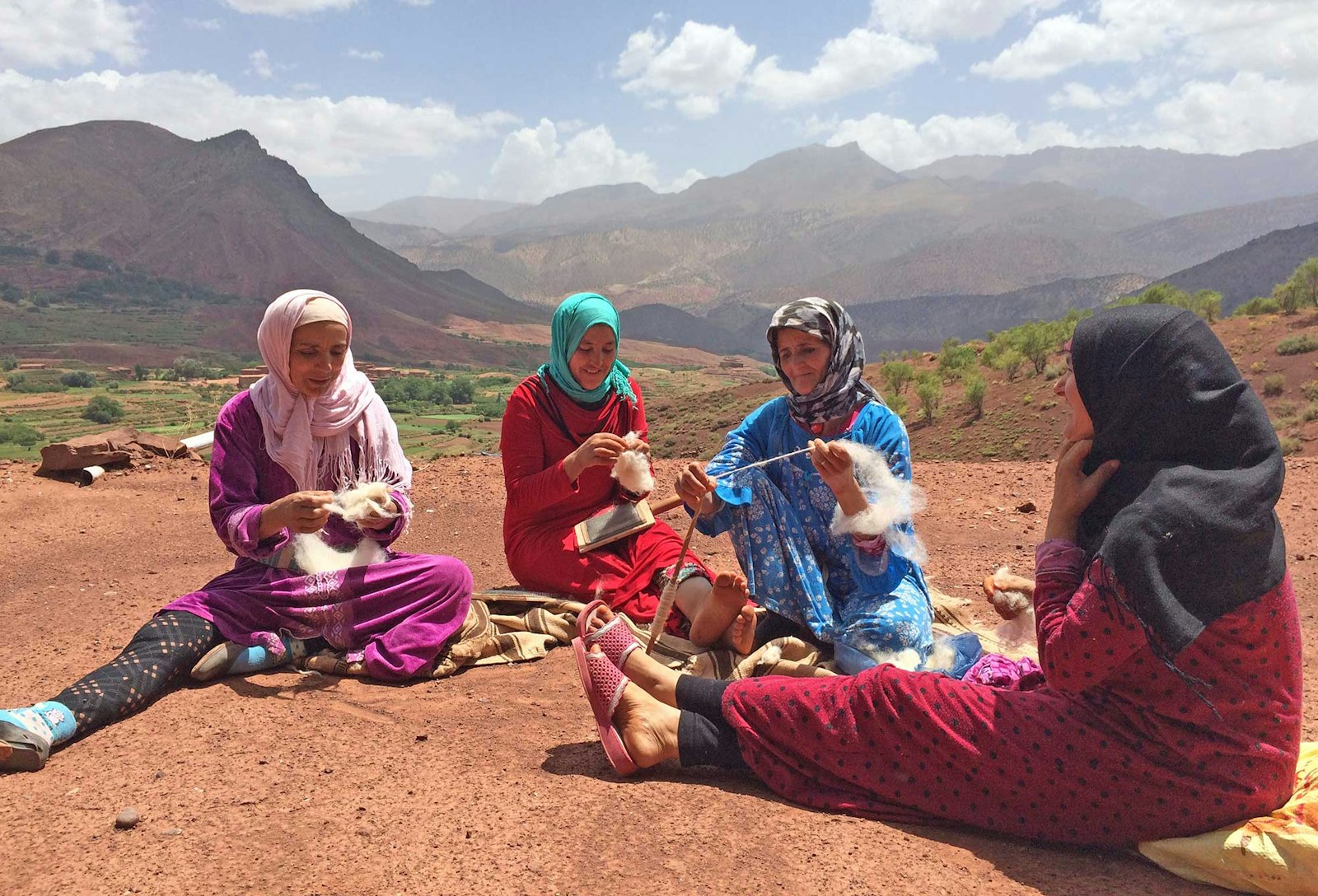
Dusty shoes lay scattered by the door, and more than two dozen women sat crowded on the floor in groups with their legs stretched out in front of them. They had come with cardboard boxes full of wool, carders, and the long, thin spindles used by spinners in this area. Some of them had black and white striped blankets across their laps, which kept their clothes clean as they carded freshly washed white wool. The room was buzzing with their voices as they talked about family, news, and their aspirations for the cooperative.
 One of the long spindles used by members of the women’s cooperative.
I went from group to group and talked with the women about the different types of wool yarn they were spinning. Some were making the loosely spun tilmi I had seen on my first visit to Timloukine. Others were spinning up a more tightly spun, two-ply ibilou yarn, which is cut into finger-length pieces and tied around the warp threads on a loom to create the thick pile characteristic of Amazigh carpets in Morocco.
A couple of the older women were drawing out a much thinner, more tightly spun yarn called ifilan n’tqasher. In their dialect of Tashelhit, ifilan simply means yarn, and tqasher means socks. The ifilan n’tqasher seemed to be a worsted or bulky weight yarn.
 While a few men still knit socks, the young members of the co-op learn to spin thick yarn for rugs vs. the finer sock yarns. Hussein Mardi taught Irene to knit socks these traditional socks.
I noticed that none of the younger women were spinning ifilan n’tqasher. I asked a young woman near my elbow if she could spin it. She smiled and shook her head explaining that only a few of the older men still knit socks, so there was no need for younger women to learn how to spin the finer yarn. Young women only needed to make the thicker yarn used for rug weaving—their main means of earning an income in a region with few economic opportunities for women.
 Irene displays the thick yarn that’s used for rugs.
Across from us was a young woman who had heard I was interested in knitting and had brought double-pointed knitting needles with her. She waved me over and placed in my hands thin, wire needles that were blunt and pinched at the tips where they had been cut. I presumed they had been made by cutting a longer piece of wire into the five needles I held. “These are wonderful!” I said. “Do you know how to knit socks?” She nodded and gestured to a neighbor who threw her a ball of freshly spun ifilan n’tqasher.
Knitting in Their Footsteps
The young woman’s hands shook as she cast on 10 stitches. More than half of the room had stopped to watch her. She was clearly nervous. “How did you learn to knit?” I asked in an effort to break the silence and deflect the attention. “Well, I’m still learning. I’ve been watching my grandfather,” she replied, seeming relieved at the chance to talk instead of knit with so many eyes on her.
“Oh! He makes socks?” I asked. “Well, not so much anymore,” she responded. “Do you have any socks that he made?” I enquired. She nodded. One by one, other women chimed in that they had socks knitted by their fathers, grandfathers, uncles, and cousins. A few of them jumped up and left the raoud. When they returned, they were carrying pairs of worn socks in the colors of Timloukine’s sheep.
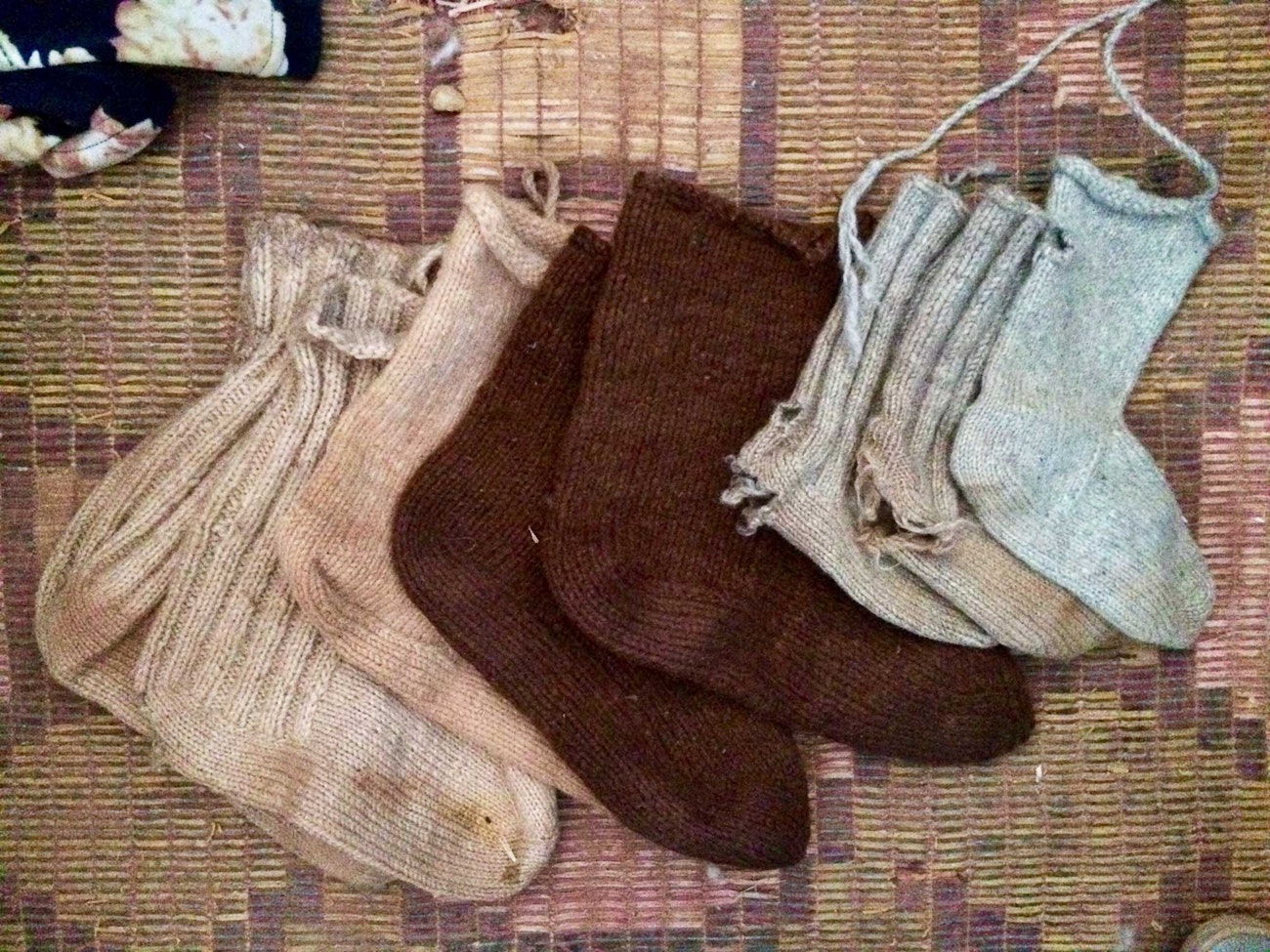
I laid out the socks in a variety of sizes and shades of cream, brown, and gray. Some were clearly for children while others must have been worn by adults. All had the distinctive tail from the cuff that enabled the wearer to hang the socks up to dry. One woman showed me that the tail was tied around the leg to keep the socks from slipping down and the cuff snug around the wearer’s pants leg, which they liked to tuck into their socks. The heels appeared to be a type of flap or band heel, and there were no gussets at the ankles.
“What wonderful socks!” I exclaimed. “These are the best when it’s cold. They’re better than the ones you get at the market,” said a woman who had brought one of the pairs in front of me. “My husband can show you, but he’s away with the sheep now.”
I had arrived in Timloukine just as the men were beginning to take the sheep up to Jebel Rat, the highest peak near the village, where the air was cooler and grazing better. There, the shepherds would stay in stone huts, only coming down for the weekly Saturday market where they would sell one or two sheep to pay for provisions like grain, soap, and oil. I had come to work with the women, so I didn’t have time to hike up Jebel Rat to visit the men—nor would it have been acceptable according to local custom for me, an unrelated woman, to go up there on my own. If I wanted to learn about sock knitting, I would have to return when the shepherds and their sheep were once again in Timloukine.
For more about the people, patterns, and history of knitting in Morocco, check out the book Keepers of the Sheep: Knitting in Morocco’s High Atlas and Beyond, available at 106MetersFromTheRoad.com.
Irene’s Ntaidrin (Wheat) Socks
From 2017 to 2020, I worked with Amazigh shepherds in the High Atlas Mountains to document the oral knitting patterns they had learned from their forefathers. These patterns are like basic recipes and are used specifically with handspun yarn. Rather than relying on gauge swatches, they require the knitter to try on the garment as it is made, resulting in something that will fit any size.
The following sock pattern is based on the “Tqasher Qadeem” or “Old Sock” pattern that was taught to me by Hussein Mardi. Hussein knit only plain colored socks with tall cuffs. For the Ntaidrin pattern, I eliminated the cuff and added motifs that are used in knitting from the region. The simple pattern is ideal for any stitch count divisible by two. This is a great way to get started making traditional Moroccan toe-up socks that can be knitted to fit any foot.
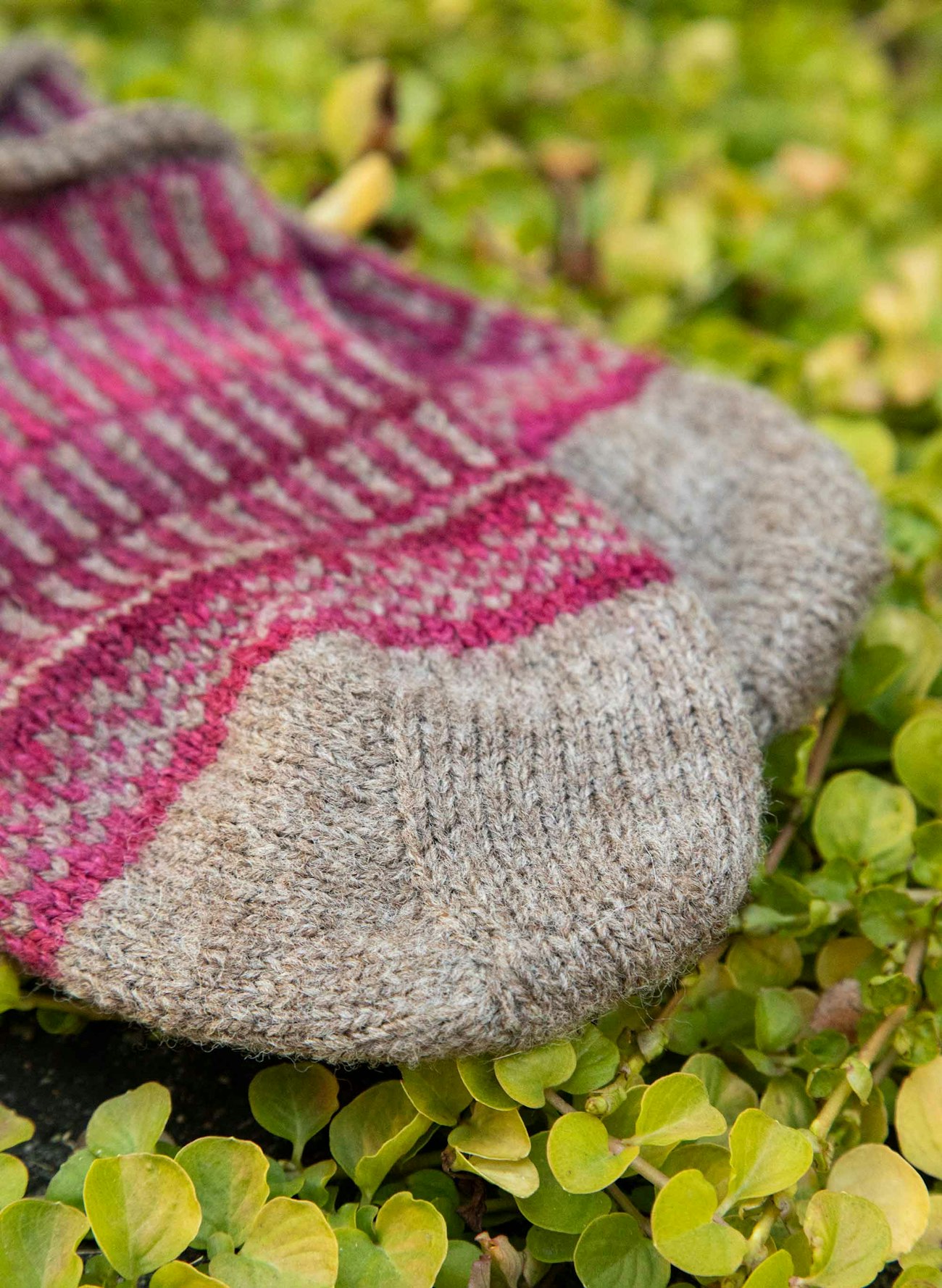
 Make Irene’s Ntaidrin (Wheat) Socks using your favorite farm yarn. Photo by Matt Graves
The pair shown here is knitted in DK-weight handspun. You can use any yarn you like, and the pattern includes some simple adjustments for yarn weight and finished size. Beginning with a diamond toe, the socks are knit-to-fit. Increase until the toe has enough stitches for your foot, and off you go!