
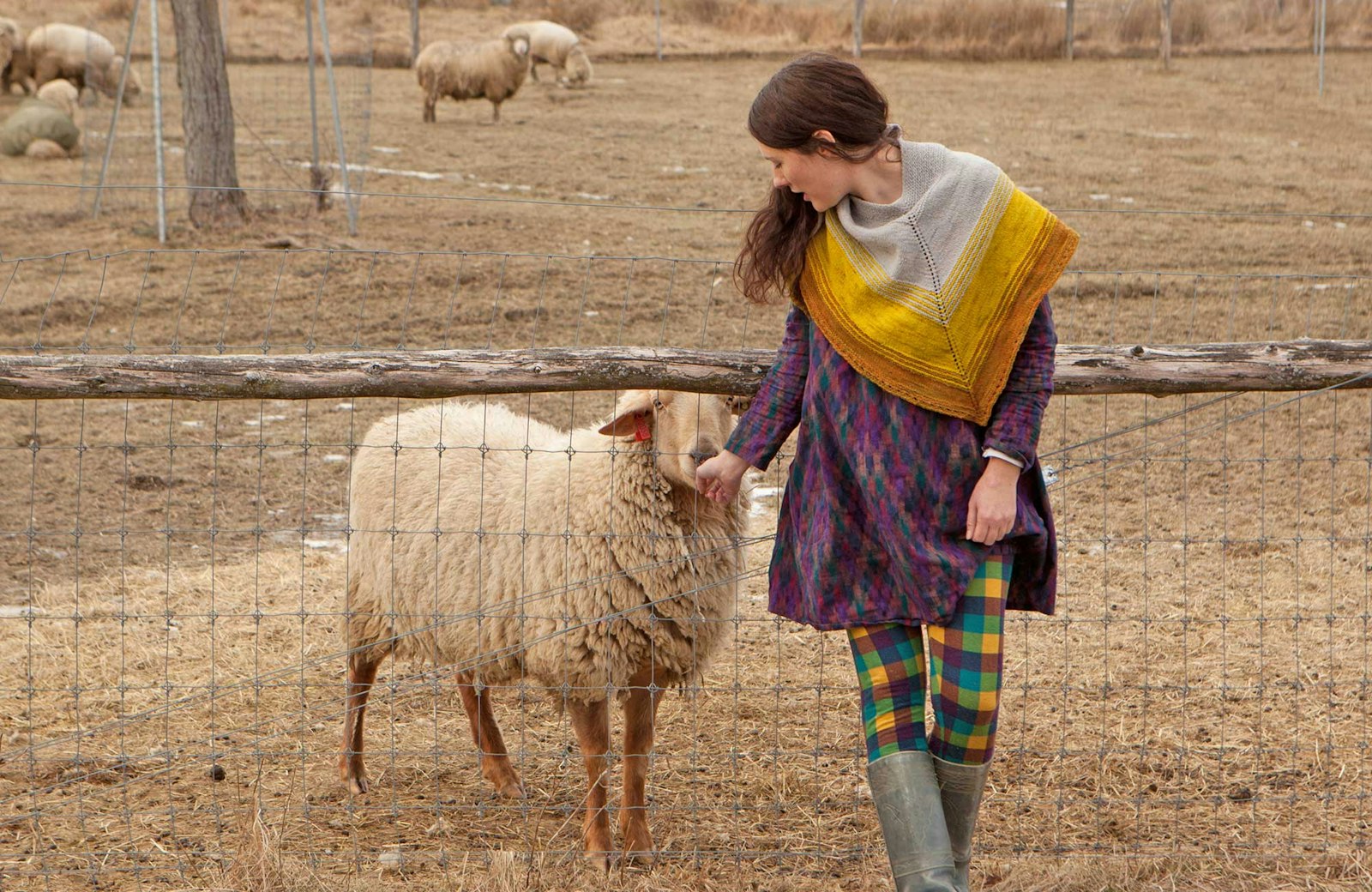
The highlight of many a knitter’s visit to the New York State Sheep & Wool Festival in Rhinebeck, New York, is a side trip to the Open Air Studio Party hosted by Jill Draper Makes Stuff. Based just across the Hudson River in the small city of Kingston, Jill Draper has been producing breed-specific, made-in-America yarn for more than 15 years.
 Kingston, a 3-ply DK-weight 100% Targhee grown in the Finger Lakes region of New York.
With a degree in Fashion Design from Pratt Institute and time spent working in yarn shops in New York City, Jill has built a business centered on celebrating local, hand-dyed wool. She recently agreed to share her story with us.
Farm & Fiber Knits: You recently posted on Instagram that you could trace your current work back to Melanie Falick’s 1996 book Knitting in America. Can you tell us more about that?
Jill Draper: Knitting in America was crucial in the journey to realize I could make yarn, possibly at scale. Seeing the profiles of people making yarn in the US was so inspiring to me that I cold-emailed Margrit Lohrer (founder of Morehouse Merino) and asked if I could work for her. It was a longer conversation, but in the end the answer was “yes.” I moved upstate from Brooklyn to work at Morehouse Merino.
FFK: How did you come to focus on local wool, and how do you define “local”? Does that mean just New York State or extending into surrounding states?
JD: I started Jill Draper Makes Stuff (JDMS) dyeing commercially available bases, and that was okay, but I really wanted bases that didn’t exist except in my imagination. I started working with mills both in the US and overseas to produce yarn to my specifications, but I had very little control over the wool types used. Most commercial wool is sold based on micron count (and a few other technical specs) but very rarely by breed. I’m a handspinner, so I knew that the different breeds have different fiber characteristics. I really wanted to make yarn that used each breed’s unique character to make more interesting yarn.
 Jill knit this motto into her pullover: “Each stitch is integral to the strength of the whole.”
I usually describe the wool I use as either traceable or domestic because the term “local” can be interpreted so many ways. All the wool is grown in the US, much of it in the Northeast, but I also have wool from both California and Montana in the line.
FFK: Do you do all the dyeing yourself?
JD: The one thing that is always done only by me is the dyeing. I buy just five colors of dye: two reds, two blues, and a yellow. Mixing the dye is a bit art and a bit science.
FFK: I know it’s like asking you to choose a favorite child, but which one of your yarns would be your desert island choice, and why?
JD: It is exactly like asking which child is my favorite! But seriously, I have designed each of the yarns to serve a purpose. If you’re forcing me to choose, I’ll say Empire, which is a Rambouillet wool and is the first yarn I had made sheep-to-skein in the US. The wool comes from a small family farm in Upstate New York. Rambouillet is next-to-skin soft, and the 4-ply structure of Empire gives it strength, so it wears well. Plus, it’s just fun to hug a giant skein of yarn!
 Empire, a 4-ply Aran-weight 100% Rambouillet wool yarn, comes in 770 g / 1280 yds skeins.
FFK: Is there a yarn in the line you think is underappreciated by knitters? What do you want knitters to know about that yarn?
JD: The most underappreciated of the JDMS yarns has to be Valkill. It is the “toothiest” yarn in the line, though I still find it easy to wear. I had it spun in a “faux single” style, similar to yarns like Lopi. Two barely twisted singles are plied together, again with a low twist, so at a glance you might think it is only a single ply. Because of this woolen-spun construction and the unique crimp of Cheviot wool, you can knit this DK-weight yarn at quite a loose gauge without losing structure or warmth. You could easily knit a sweater on size 10 needles with Valkill and still wear it to shovel snow.
 Valkill, a Lopi-style yarn, was used to knit Foxhall Studio, designed by Kristen Kapur.
FFK: I love the handwoven blankets in your shop! Why did you decide to sell finished products? Where is the weaving done?
JD: I love textiles, and I love wool blankets! I was surprised at the dearth of made-in-the-US wool textiles. Coming from a background of fashion design, I was excited to get back into designing more than “just” yarn. The weaving is done by hand in Connecticut. The blankets, yardage, and shawls are a collaboration between the weaver and me. I have a basic knowledge of weaving and ideas about what I want. I send her lots of yarn and either sketches or rough ideas. She weaves a bunch of swatches. We go back and forth refining the design until we decide on the final product. I never see the finished blankets until the full batch is off the loom.
 Jill Draper has her blankets handwoven in Connecticut using Dorset wool grown in New York State.
FFK: How do you imagine your business evolving? Are there new products you’d like to develop, dfferent fibers you’d like to explore?
JD: I hope to keep introducing new yarns. I want to lean more into textiles and home goods; I really enjoy designing them and people seem to enjoy using them!
You can find yarn from Jill Draper Makes Stuff on her website, at fiber festivals, and at yarn stores around the country. JDMS handwoven blankets, shawls, and yardage are available via the website.