
Jane Austen was born on December 16, 1775, and at that time, England was surging into the Industrial Age. In times of great social change, as in the latter half of the 1700s, transformation seems to cascade through culture and day-to-day life. The English population was growing, as were towns and cities, and major changes in agriculture were needed to support this growing economy.
In a 1798 letter to her sister, Cassandra, Jane wrote of one of their father’s noteworthy Leicestershire sheep. At that time, sheep carrying the Leicester (pronounced lester) name were undergoing changes that would not only influence many breeds of sheep around the globe, but the as yet uncharted field of genetics. Carefully planned selection and “improvements” in the large-framed longwool sheep of Leicestershire by a farmer named Robert Bakewell (1725–1795) would change history.
 The Leicester Ram graced the frontispiece in William Youatt’s 1837 edition of Sheep: Their Breeds, Management, and Diseases. Courtesy of North Carolina State University
Bakewell returned from his travels in Europe to the English Midlands and set out to improve the flock of sheep at his father’s farm, Dishley Grange. He developed a new breed, which he called the Dishley Leicester or New Leicester, through a system of selection and breeding that he called In and In (now called line breeding). Bakewell would eventually become one of the most noteworthy figures in the history of animal husbandry and made his contributions to the field of genetics before either Charles Darwin or Gregor Mendel were born.
Read the full article about Leicester sheep in Jane Austen’s England in the Farm & Fiber Knits Library.
Knitting with Leicesters
The original article on Leicester sheep from Jane Austen Knits was paired with a woolly tea cozy pattern that included a full alphabet so you could create your own monogram. It’s a perfect project to explore modern Leicester wools. Three breeds descend from Bakewell’s flock: The Leicester Longwool, Border Leicester, and Bluefaced Leicester.
 Locks from left: Leicester Longwool, Border Leicester, and Bluefaced Leicester. Photo by Kate Larson
While the Bluefaced Leicester is easy for us to find in yarn stores today, Leicester Longwool and Border Leicester yarns are harder to source. Both of these breeds have long, lustrous locks that form as ringlets or silky waves. For the tea cozy pattern, a great yarn to check out is Border Leicester Sport from The Ross Farm. Look at that luster!
 Look at that luster! Border Leicester Sport from The Ross Farm. We think this combo of madder and natural white would be lovely.
Find the pattern for Mrs. Smith’s Tea Cozy in the Farm & Fiber Knits Library.
 Mrs. Smith’s Tea Cozy is knitted using stranded colorwork in the round with steeks.
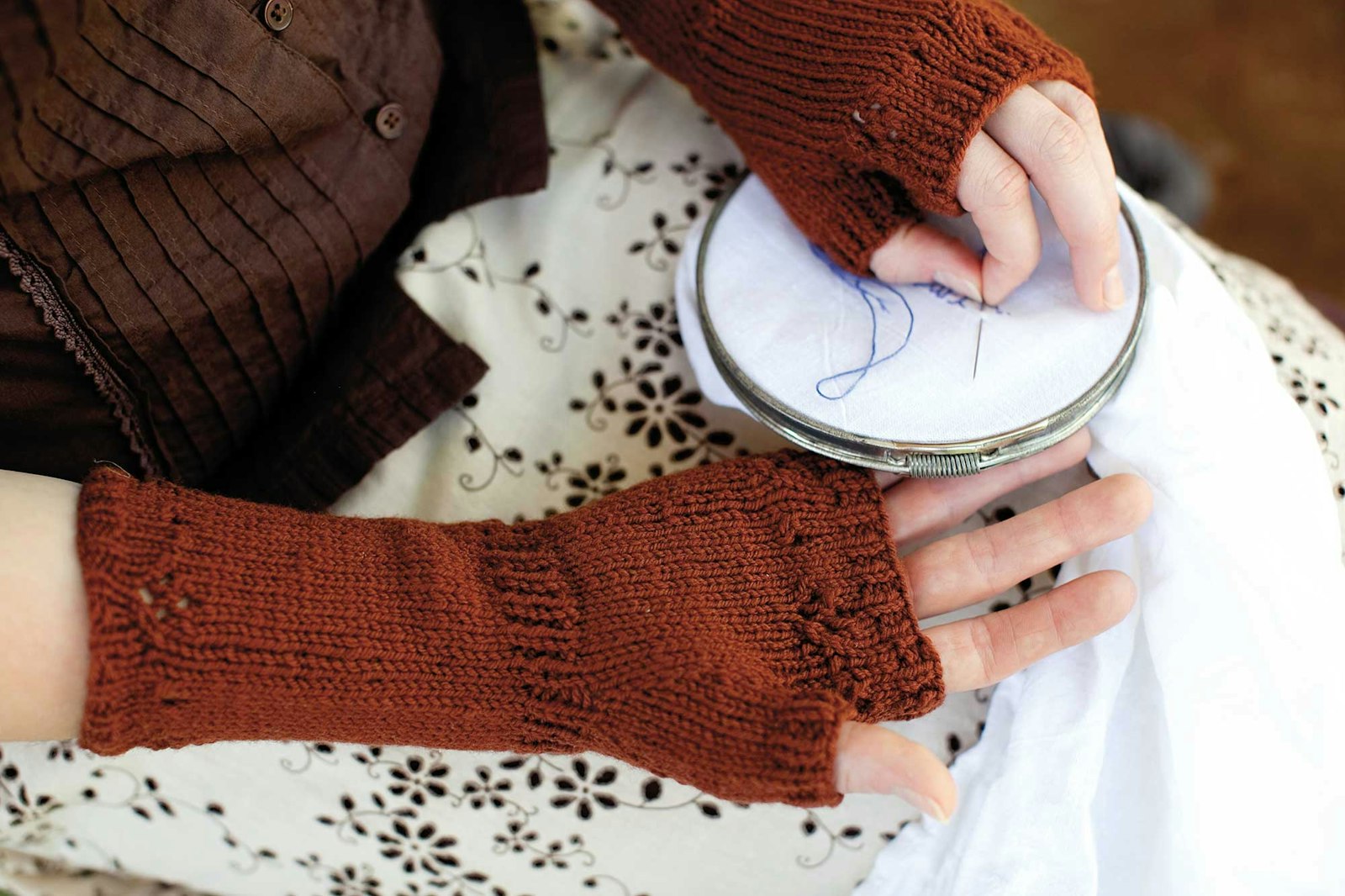
We’ve also pulled a mitt pattern from the archive, which would be a great opportunity to use Bluefaced Leicester, which is a finer, softer fiber. You could also explore some of the other sheep breeds that were well established before Jane Austen’s day: Romney, Dorset, Shetland, and more. Bare Naked Wools has some great breed-specific sportweight yarns, including Shetlandia, which comes in five natural sheepy shades.
Find the pattern for the Open Carriage Gloves in the Farm & Fiber Knits Library.
We hope you’ll enjoy a bit of knitting in Jane’s honor this December!
 The Open Carriage Gloves by Meg Roke.